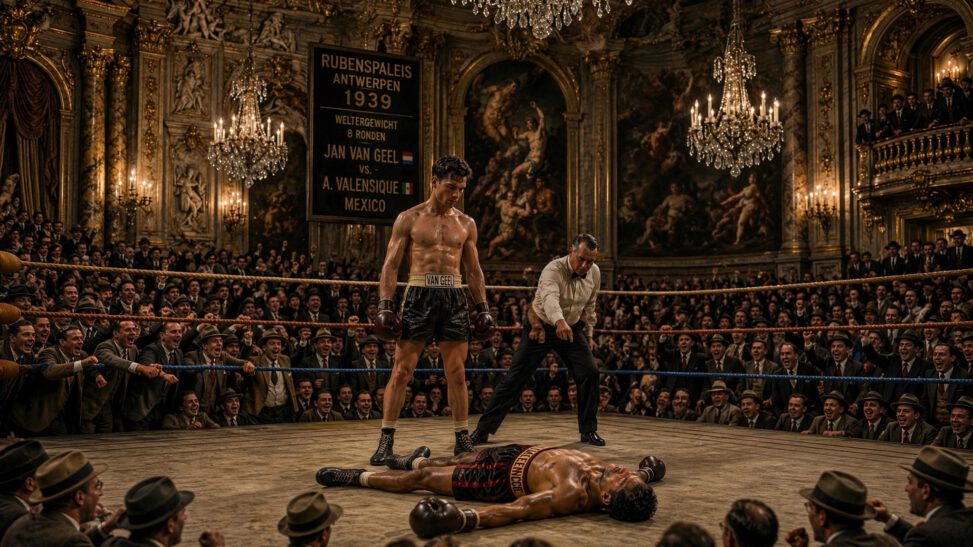
A boxing ring is a small, brutal place to hold a life. There is nowhere to hide from fear, humiliation or the need to prove yourself.
That is why historical fiction with boxing can carry such unusual force. It turns private pain into public conflict and places it against a world already shaped by war, poverty, prejudice and loss.
The strongest stories do not use boxing merely for spectacle. They understand that a fighter may enter the ring for money, pride, survival or revenge — and that every reason says something about who he is.
Boxing makes history physical
History can feel distant when reduced to dates and political decisions. Boxing returns it to the body.
A broken knuckle, a split brow or a final exhausted round reminds us that the past was lived by people who were hungry, frightened, injured and tired.
This is especially powerful in fiction set around the Second World War. Behind the invasions and bombed cities were ordinary people trying to earn money, protect families and live with what they had seen.
For a boxer, the ring may offer income, control or identity. For a son, watching his father fight may create a legend that later turns into harder questions.
The ring exposes character
Two men face one another. Every hesitation is visible. Pride can become panic. Courage can become cruelty.
That makes boxing useful in a novel with a larger plot. A robbery, betrayal, romance or family secret may unfold over years, but a fight can reveal its emotional stakes in minutes.
A boxer who refuses to stay down may be brave. He may also be incapable of admitting defeat anywhere in his life.
Class, survival and boxing
The sport has offered discipline, friendship and a route out of poverty, but it has also exploited desperate men and left lasting damage.
A fighter can be admired by his neighbourhood while being used by promoters. He may become famous without becoming free. His victories can make him a hero while his family lives with his absences, anger or injuries.
That contradiction gives boxing fiction its depth.
War and boxing
War and boxing are not the same, but fiction can use the tension between them.
Both demand endurance and reward aggression. In each, men are expected to display courage in front of others. Yet the wounds can remain long after the danger has passed.
A man who seems fearless in the ring may still carry memories he cannot explain. His family experiences the silences, sudden anger or distance that follow.
This is where a boxing novel becomes more than a sports story. It can show how ideas about strength leave little room for grief.
The best fights are never only about punches
Readers do not need every bout described blow by blow.
A fight matters when it reveals character, changes a relationship or alters the plot. A boxer may throw a contest to protect someone. He may win and discover the promised reward was a lie. His son may see him defeated and understand the cost of the legend.
Historical detail still matters, but only when it serves the story. The reader should feel the hall, the crowd, the money and the danger.
What matters most is not the punch itself, but the wound it lands on.
When fact sharpens the story
Historical fiction based on true events has an extra responsibility.
Newspaper clippings, photographs and records can show that a world really existed. But they cannot tell us what happened inside a marriage, what a child believed or what a man refused to say.
That tension lies at the heart of The Fourth Gold Bar, where boxing, war, betrayal and a gold robbery are tied to the long shadow between father and son.
The action matters because it leaves consequences.
What makes boxing-centred historical fiction memorable
The strongest novels avoid simple heroes.
A fighter can be brave and selfish, loving and destructive, admired and deeply flawed. The sport may give him identity, but it does not excuse the damage he causes.
That is where the real story often lies: not only in who wins the fight, but in who lives with the consequences afterwards.
A boxing ring is bounded by ropes. The choices made inside it are not.
The Fourth Gold Bar is an autofictional historical novel by John B. Gieles, inspired by family history, war, displacement and the lasting effects of silence between generations.