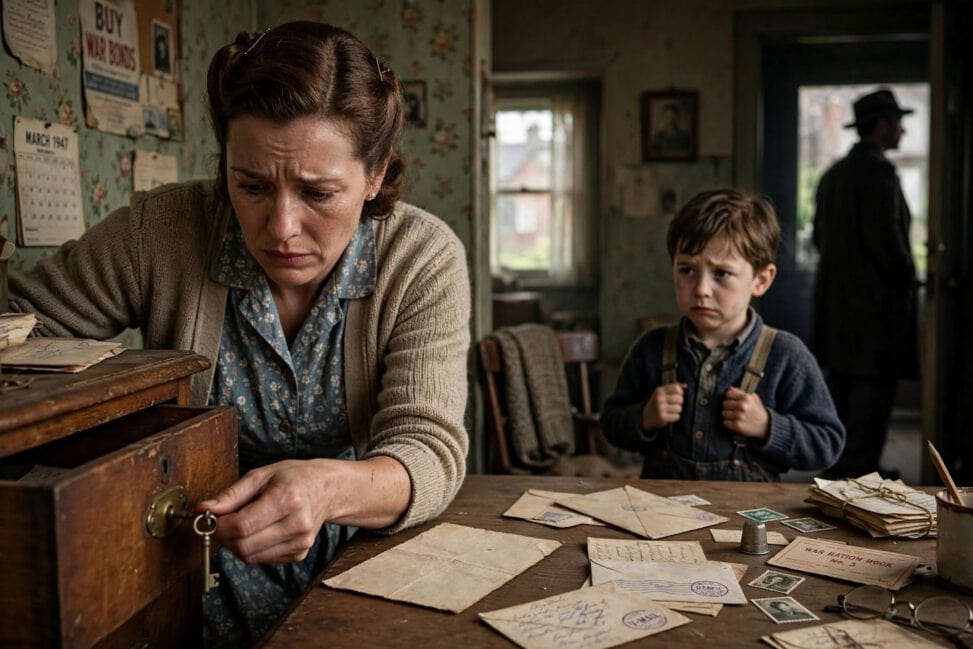
How wartime secrets affect families often becomes visible in small things: a locked drawer, a photograph turned face-down, or the sudden silence when a name is mentioned. Long after the guns fall quiet, these absences can become part of a family’s identity.
A child notices the locked drawer before understanding what it means. A photograph is turned face-down. A name causes sudden silence. A father refuses to speak about the years before his children were born.
Long after the guns fall quiet, such absences can become part of a family’s identity. They show how wartime secrets affect families not only through what happened, but through what nobody was allowed to ask.
War forces people into choices that would have seemed unthinkable in peacetime. Some return home carrying memories they cannot bear to share. A secret may begin as protection. Decades later, it can feel like an inheritance.
This is one of the clearest ways wartime secrets affect families across generations.
Silence rarely ends with the person who keeps it
Parents may believe that silence protects their children from violence, betrayal, shame or loss. Yet children are remarkably sensitive to what remains unspoken. They may not know the facts, but they feel the tension.
A father who cannot tolerate a slammed door or struggles to show affection is communicating something even when he says nothing. A mother who refuses to discuss a missing husband may be preserving a memory, hiding a betrayal or simply trying to survive.
Children grow up around those boundaries. They learn which questions are dangerous.
This is how wartime secrecy becomes more than history. It enters ordinary family life: who is trusted, how anger is expressed and what kind of love feels safe.
How Wartime Secrets Affect Families Across Generations
The first generation carries the event. The second often carries its consequences. The third may inherit the unease without knowing where it began.
For people who lived through war, secrecy could once have been necessary. Names, hiding places and loyalties could mean imprisonment or death. Even after peace returned, the habit of concealment did not always disappear.
Their children may experience that silence differently. When a parent refuses to discuss the past, a child may conclude that true intimacy is impossible — or that they do not deserve the truth.
By the time grandchildren start asking questions, the witnesses may be gone. What remains can be surprisingly small: an unfamiliar surname, a medal in a drawer, a newspaper clipping or a bundle of old letters.
Such discoveries can change a family story completely. A celebrated hero may also have abandoned someone. A distant grandmother may have spent years waiting for news that never came.
The truth can increase understanding, but it cannot erase the pain created by years of silence.
The deepest damage may be uncertainty
Not every family secret is one dramatic revelation waiting to be uncovered. Sometimes it is simply an atmosphere.
Everyone senses that something happened, but nobody has permission to name it.
That can create a peculiar kind of grief. Descendants may mourn a relationship they never had or a relative they never truly understood. They may also feel guilty for wanting answers from someone who endured genuine hardship.
Understanding is not the same as excusing.
A father may have had understandable reasons for hiding an affair, a false identity, a robbery or an act he regretted. His child can still suffer from growing up without honesty.
Both realities can exist at once.
Painful facts at least have boundaries. Silence can spread into every room.
Fathers, sons and the search for approval
Wartime stories often return to fathers and sons because the emotional stakes are so high.
A son may inherit his father’s name, mannerisms and temper while knowing almost nothing about the experiences that shaped him. He senses that he is being measured against an invisible past.
Perhaps the father survived war but returned unable to show tenderness. He may have disappeared repeatedly, leaving his son with a myth instead of a dependable parent. In other families, the proudest story may later prove incomplete.
The question then becomes deeply personal:
Who was my father, and what does his past mean for me?
That search can last a lifetime.
Why discovering the truth matters
Revelation is not a cure.
A letter or confession cannot restore a lost childhood or repair every damaged relationship. Families may disagree about what the evidence means or whether the past should have remained private.
But truth provides context.
It separates what actually happened from the stories people created because they did not know. A harsh parent may become more understandable. An apparently shameful act may reveal courage. A treasured family legend may turn out to be incomplete.
Real lives are rarely simple.
People can be brave and selfish, loving and damaging, loyal and frightened at the same time. War places ordinary people under extraordinary pressure and then leaves families to live with the consequences.
Why historical fiction returns to family secrets
Historical fiction can explore what official records often cannot.
A service record can establish where someone was. A newspaper can record a death. A document can provide a date.
Fiction can explore what surrounded those facts: the unsent letter, the unanswered question, the glance between two parents when a child enters the room.
That is why wartime family stories remain compelling. The suspense is not simply whether the secret will be uncovered. It is whether the people left behind can live with what the truth reveals.
The Fourth Gold Bar enters precisely this territory: a father, a son, a war and choices whose emotional consequences last for decades.
Peace may end a war. It does not always end what the war set in motion.
For families confronting a concealed past, the most important question may therefore be a simple one:
What did this silence cost us — and what might change if we finally gave it a name?