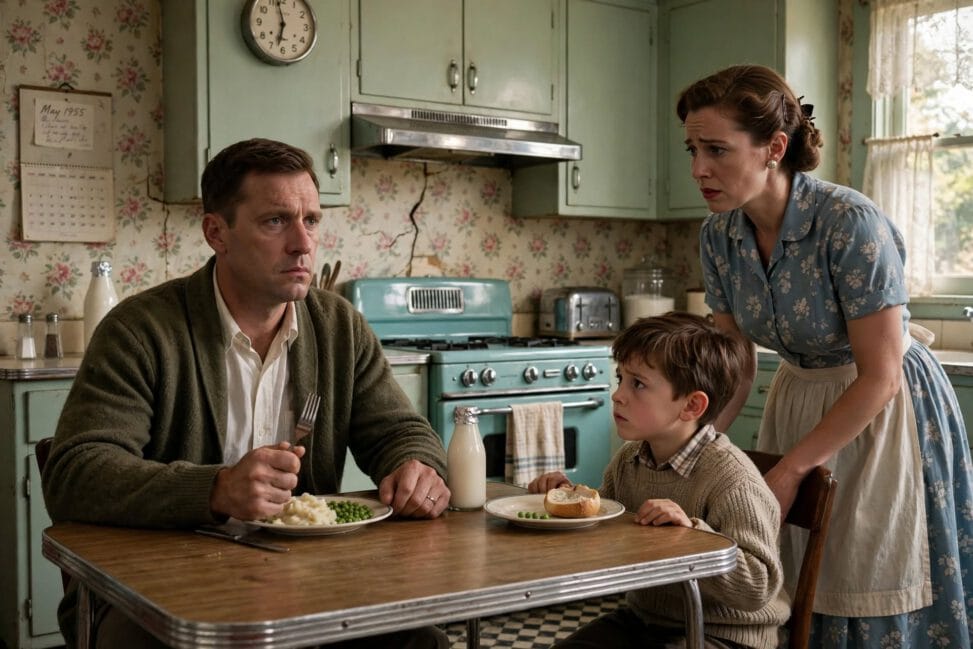
A child may grow up long after the guns have fallen silent, yet still learn to listen for danger.
He may know nothing of the prison camp, the bombing raid, the lost brother or the father who came home changed. Still, he notices the tension at the dinner table, the sudden anger and the silence around certain names.
Can trauma pass through generations?
The evidence suggests that the effects of trauma can, although not as a simple inheritance of memories or destiny. What travels through a family may be a way of loving cautiously, avoiding difficult subjects, expecting danger or leaving before being left.
For families marked by war, displacement, violence or abandonment, the past can remain present even when nobody speaks about it.
What is intergenerational trauma?
Intergenerational trauma describes the way the consequences of traumatic experiences in one generation can affect later generations.
A son does not inherit his father’s wartime memories as he might inherit his eyes or surname. But a parent who has lived through overwhelming events may struggle with trust, anger, closeness, anxiety or emotional absence. Those difficulties can shape the environment in which a child grows up.
A father who cannot speak about what he experienced may appear cold rather than wounded. A mother who survived deprivation may become intensely protective of food, money or security.
Children often learn the rules without knowing where they came from:
Do not ask too much. Do not show weakness. Do not trust too easily.
Over time, those rules can become part of a family’s emotional language.
Researchers describe several possible pathways, including parenting and attachment, family communication, social conditions and biological stress systems. Researchers are still studying the exact mechanisms.
The weight of silence
Silence is often mistaken for strength, particularly among people who survived war.
Many returned home to families who needed ordinary life to resume. Some believed that speaking about the past would burden their children. Others simply had no words for what they had experienced.
But silence does not erase an event.
Children are remarkably sensitive to what adults avoid. They notice a face changing at a name, a sudden outburst or a father disappearing into work, drink or emotional distance. Without an explanation, children may invent one — and sometimes blame themselves.
That is why complete secrecy can cause harm. A child may feel the consequences of an event without understanding its cause.
When history becomes personal
History is often told through dates, battles and political decisions. Inside a family, history is far more intimate.
It is the father who never learned how to comfort his son.
A woman may continue storing food long after hunger has disappeared.
A child may learn that love can vanish without warning.
This is why father-son stories can carry such emotional force. A father may be physically present but emotionally unreachable, shaped by experiences his son cannot yet understand.
By the time the truth emerges, both may have built lives around what was never said.
Historical fiction can make that private cost visible. In The Fourth Gold Bar, war, betrayal, hidden gold and danger do not end when the fighting stops. Their consequences enter a family and continue into the relationship between father and son.
What does science say?
Research supports the idea that severe trauma can influence parenting, attachment, mental health and family functioning across generations.
Children of traumatised parents may show greater vulnerability to anxiety, depression or difficulties with emotional regulation, although outcomes vary widely and many other factors also influence them. Supportive relationships and safer environments can reduce those risks.
There is also growing interest in epigenetics — changes that affect how genes are regulated without altering the underlying DNA sequence.
Studies involving descendants of people exposed to famine, genocide and war have found differences in DNA methylation and stress-related biological systems. But the human evidence remains preliminary. Studies are often small, methods differ, and researchers cannot easily separate biology from upbringing, poverty, discrimination or family environment.
So it would be misleading to say that trauma passes biologically from one generation to the next in a fixed or inevitable way.
What the evidence shows more clearly is that trauma can shape relationships, behaviour and emotional patterns — and those can influence the next generation.
Signs that an old wound may still be active
Not every reserved parent is traumatised, and not every troubled family carries a hidden historical catastrophe.
Still, certain patterns may deserve attention: reactions that seem much larger than the present situation, repeated family estrangements, shame around emotion, an inability to discuss loss, or a family history full of unexplained gaps.
Sometimes children take on roles: the peacemaker, the outsider, the responsible one.
Those roles may once have helped a family survive. Later, they can make ordinary intimacy more difficult.
Recognising such patterns is not about putting parents or grandparents on trial. A person can understand what damaged a parent while still acknowledging the damage that parent caused.
Can the pattern be broken?
Yes.
Intergenerational trauma is not destiny.
Supportive relationships, greater safety, open communication and psychological treatment can help interrupt patterns that once seemed permanent. Supportive adult relationships can offer strong protection.
Sometimes healing begins simply with somebody asking:
What happened in our family — and why did nobody talk about it?
For others, especially where there has been violence, abuse, addiction or severe psychological distress, professional help may make that exploration safer.
The aim is not to force forgiveness or recover every missing fact. It is to understand enough of the past that it no longer silently controls the present.
A family history may contain war, abandonment and secrets that shaped lives for decades.
But it may also contain the moment someone decides to tell a truer story.
That is how an inherited wound can begin to lose its power.
Further reading: American Psychological Association; World Health Organization; recent reviews on intergenerational trauma and epigenetics.