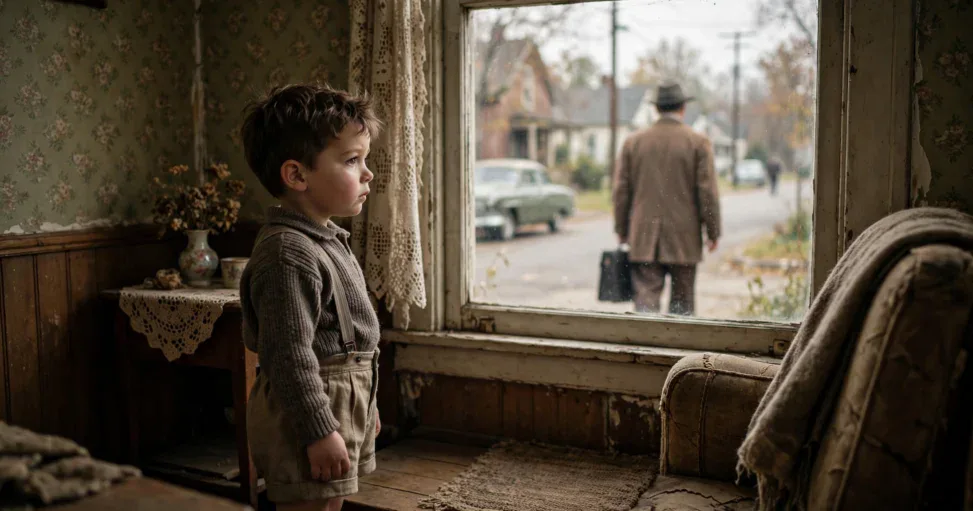
Growing up without a father can leave emotional wounds that remain invisible for decades. A child may learn to survive without paternal love, protection or guidance. Yet the unanswered questions can follow him into adulthood, shaping his relationships, ambitions and understanding of himself.
Sometimes, the deepest wound is not simply that a father leaves. It is that a child never understands why.
And sometimes, years later, that child becomes a father himself.
A little boy standing between his parents
It was raining heavily outside. Thunder rolled across the sky, and lightning briefly illuminated the small room.
Inside, a marriage was falling apart.
A young boy lay awake in his bed, listening to his parents arguing. His mother had discovered that his father had been unfaithful. Anger, humiliation and desperation filled the room.
Suddenly, his father struck his mother.
The little boy dropped his teddy bear, climbed out of bed and rushed towards them. Standing between his parents, he pushed against his father’s knees.
“Daddy, you mustn’t hit Mummy! I’m angry with you. When I’m big, I’ll hit you too!”
The father left the house and disappeared into the rain.
For the boy, the world had suddenly become incomprehensible.
A few days later, when his mother began packing their belongings, he asked where his father was.
“I don’t know where Daddy is, darling.”
“Why don’t we look for him, Mummy?”
It was a simple question. Yet behind it lay a child’s desperate need to restore the world he knew.
This scene, reconstructed from family history in the historical novel The Fourth Gold Bar, captures something that many children experience in different circumstances: the bewilderment of losing the presence of a parent without understanding the reasons.
Growing up without a father means growing up with questions
Children depend on their parents for more than food, shelter and practical care. They also seek emotional security, affection and reassurance that they matter.
When a father disappears from daily life, a child may struggle to understand what has happened.
Why did he leave? Does he still love me? Will he come back? Did I do something wrong?
Adults may understand that separation results from complicated relationships, personal failures or circumstances beyond a child’s control. Young children, however, often lack the information and emotional maturity needed to interpret these events.
As a result, some begin to search for explanations within themselves.
A child may quietly wonder whether he was not important enough to make his father stay.
That belief is not inevitable. Children respond differently to parental absence, and loving relationships with other adults can provide considerable protection and stability.
Nevertheless, the questions themselves may remain.
Years later, the child may no longer expect his father to return. Yet he may still want to know why he left.
When parental absence becomes part of your identity
The absence of a father is not always a single event. Sometimes it becomes part of the emotional background against which a child grows up.
A boy may become remarkably independent. He learns to make decisions, solve problems and manage disappointment without expecting much help.
From the outside, this independence may look like strength.
And often it is.
However, independence can also conceal a reluctance to depend on others. If important relationships have proved unreliable, trusting someone may require an unusual degree of courage.
Some children respond by withdrawing. Others seek reassurance, achievement or recognition.
For a child who rarely felt noticed, being seen can become particularly important.
Success at school, in sport or later in a professional career may offer a sense of worth. Achievement can become a way of answering a question that has never entirely disappeared:
Am I good enough to be loved?
Of course, ambition has many possible origins. It would be too simple to claim that every ambitious adult is compensating for childhood rejection.
But in some lives, the desire to accomplish something and the desire to be acknowledged become closely connected.
The adults who help a child survive
A father’s absence does not mean that a child must grow up without meaningful emotional relationships.
Teachers, relatives, foster parents, residential care workers and other trusted adults can become profoundly important.
A child may discover that affection and security are available beyond his immediate family.
Sometimes these relationships are temporary. Yet even a temporary relationship can leave a lasting impression when an adult offers genuine interest, consistency and warmth.
For children growing up in institutions, such experiences can be especially significant.
The experience of being noticed by someone who expects nothing in return can help a child develop trust in others.
However, repeated separations may also make attachment complicated. A child learns to love someone while knowing that the relationship might end.
Consequently, the wish for closeness can exist alongside a powerful fear of losing it.
This contradiction may continue into adulthood.
The father who survived a war but could not remain a father
War can make a complicated family history even more difficult to understand.
A man may survive imprisonment, forced labour, bombardment or other life-threatening experiences. He may demonstrate extraordinary courage and resourcefulness.
Yet survival does not necessarily prepare him for the emotional responsibilities of marriage and parenthood.
The skills that helped him endure danger may not help him understand the needs of a frightened child.
In The Fourth Gold Bar, Jan van Geel is a Dutch boxer whose life is transformed by the Second World War.
His experiences lead him through forced labour, imprisonment, escape, forbidden love, betrayal and a robbery involving stolen Nazi gold.
He is courageous, restless, ambitious and determined to survive.
But he is also a deeply contradictory man.
The choices that make his wartime story extraordinary eventually contribute to the destruction of his family life.
His son is left to grow up largely without him.
This creates the central emotional tension of the novel: how can a son admire aspects of his father’s courage while struggling to accept his failure as a parent?
Understanding the past does not mean excusing the harm.
Both truths can exist at the same time.
When the abandoned child becomes a father
Perhaps one of the most complicated consequences of growing up without a father emerges years later, when the child has children of his own.
For many people, parenthood is influenced by memories of being parented.
They remember how their father comforted them, corrected them, played with them or made them feel safe.
But what happens when those memories are missing?
A man who grew up without a reliable father may have to develop his own understanding of what fatherhood requires.
He may genuinely love his children and still find the everyday responsibilities of being emotionally present unfamiliar.
The difficulty is not necessarily a lack of love.
Sometimes it is the absence of an example.
In my own life, I discovered that becoming a father did not automatically provide me with an inner model of fatherhood.
I had to remind myself consciously that I was a father and that my children needed more than material security.
At the same time, I possessed a strong desire to achieve things, to create something meaningful and to be recognised.
Occasionally, those ambitions competed with the quieter responsibilities of family life.
Looking back, I recognise that tension more clearly than I did at the time.
I was fortunate that my children’s mother was a devoted and loving parent.
That does not remove my own responsibilities. But it forms an important part of the story.
And it illustrates something essential: childhood experiences can influence the way we approach parenthood without determining the kind of parent we must become.
Why understanding an absent father does not require forgiveness
As children grow older, their understanding of their parents may change.
An absent father who once appeared simply selfish or indifferent can gradually become a more complicated figure.
Perhaps he experienced trauma. Carried guilt or shame. Perhaps his emotional limitations developed long before his children were born.
Historical circumstances may provide explanations that were unavailable during childhood.
Nevertheless, understanding a father’s behaviour is not the same as approving of it.
A son may recognise his father’s suffering while continuing to feel the consequences of abandonment.
He may discover admirable qualities in the man without denying the pain he caused.
Forgiveness, if it comes at all, cannot be demanded.
Sometimes the most meaningful achievement is simply reaching a more complete understanding of the past.
Writing the story that was never explained
For many years, I tried to understand what had happened between my parents.
Repeatedly my sister and I asked them, but neither offered a complete explanation.
My mother spoke reluctantly about my father’s infidelity, then avoided discussing him. My father, meanwhile, continued to speak respectfully about her but remained unwilling to explain the events that had divided our family.
Their silence left questions that persisted for decades.
Eventually, writing became a way of approaching those questions.
I began reconstructing my father’s extraordinary life, placing personal memories alongside historical events and the circumstances in which difficult choices had been made.
Not every question could be answered.
Some scenes required literary reconstruction, and the distinction between established events and imagined dialogue remained important.
But fiction allowed me to explore the emotional reality of a family history that had never been fully explained.
It also allowed me to see my father as more than the man who left.
He had been a boxer, a prisoner, a survivor, an adventurer and a man driven by ambitions that sometimes overwhelmed his responsibilities.
None of those identities erased the father I had missed.
Yet together they helped me understand the human being behind the absence.
The invisible wounds do not have to define a life
Growing up without a father can shape a person’s understanding of love, trust and belonging.
But it does not prescribe the future.
Children can develop meaningful relationships, become caring parents and build fulfilling lives despite early experiences of abandonment.
The past may influence them without controlling them.
For some, understanding that distinction takes years.
For others, it takes a lifetime.
What matters is recognising that the absence of a father is part of a person’s history, not the complete explanation of who that person becomes.
And sometimes, telling the story is a way of finally giving the child who once waited for his father something he never received.
Not the father’s return.
But an understanding of why he never came back.
The Fourth Gold Bar by John B. Gieles is a historical novel inspired by true events. Combining wartime adventure, boxing, stolen gold and forbidden love, it tells an intensely personal story about paternal absence, family secrets and a son’s lifelong search for understanding.