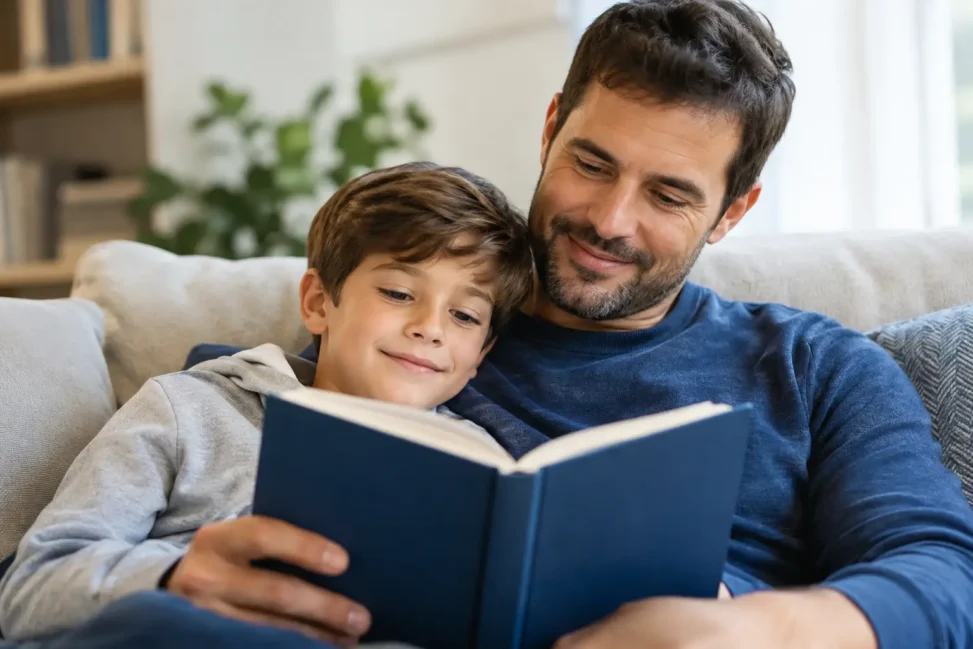
A father can be absent and still govern a son’s life. He can leave behind a name, a wound, a silence at the dinner table, or one decision made during wartime that follows the family for decades. The best books about father son relationships understand that the bond is rarely simple. Love may be expressed as duty. Anger may conceal longing. A son may spend a lifetime trying either to become his father or escape him.
For readers drawn to history, family secrets and characters forced to live with the consequences of the past, these books offer more than tender reconciliation. They contain violence, loyalty, rivalry, betrayal and the ache of things left unsaid. Some are rooted in war; others turn their attention to the private battles fought inside a family home.
Why father-son stories carry such force
The father-son relationship is a powerful engine for fiction because it holds two opposing impulses at once: inheritance and resistance. A son receives a history before he has the language to question it. He may inherit courage, prejudice, shame, ambition or a capacity for survival. What looks like an individual choice can turn out to be an old family pattern wearing a new face.
The most memorable novels do not reduce fathers to villains or sons to victims. They allow room for contradiction. A hard father may be shaped by fear. A distant father may be carrying grief he cannot name. A son who judges him harshly may eventually discover that he has repeated part of the same damage. That tension gives these stories their lasting emotional charge.
12 Books About Father Son Relationships to Read.
Fathers and Sons by Ivan Turgenev
Few novels examine the conflict between generations with such clarity. Turgenev places fathers who value tradition against sons convinced that the old world deserves to be torn down. Beneath the arguments about politics, class and belief lies something more personal: the pain of wanting recognition from the very people whose values you reject. It remains sharp because every generation believes it is the first to see clearly.
The Road by Cormac McCarthy
In a burnt and dangerous landscape, an unnamed father guides his young son towards an uncertain future. The plot is stripped to survival – food, shelter, cold and the threat of other people – but its real power comes from the father’s desperate wish to preserve his son’s goodness. This is a bleak book, and not an easy one, yet its tenderness is all the more devastating for the darkness surrounding it.
The Great Santini by Pat Conroy
Ben Meecham grows up under the shadow of his formidable Marine pilot father, Bull Meecham. Bull is charismatic, cruel, competitive and, at times, painfully vulnerable. Conroy refuses to make the relationship comfortable. Instead, he shows how love can exist beside humiliation, and how a boy’s fight for independence can become a fight for emotional survival.
A River Runs Through It by Norman Maclean
Maclean’s restrained, beautiful novella follows two brothers and their Presbyterian minister father in early twentieth-century Montana. Fly-fishing becomes the family’s language: a discipline, a ritual and a way of saying what ordinary conversation cannot hold. The father’s influence is quiet rather than tyrannical, but the novel understands that even gentle love cannot always protect a son from his own destructive choices.
The Kite Runner by Khaled Hosseini
Amir’s longing for his father Baba’s approval shapes almost every decision he makes. Set first in Afghanistan and later in exile, the novel connects private guilt with a country broken by invasion and political violence. Baba is physically imposing and morally complex, while Amir is sensitive, fearful and hungry to prove himself worthy. Their relationship gains new meaning as buried truths come to light.
East of Eden by John Steinbeck
Steinbeck’s California epic gives father-son conflict a near-biblical scale. Adam Trask struggles to love his twin sons, Cal and Aron, without understanding the different needs each boy carries. Cal, especially, fears he has inherited darkness and seeks his father’s blessing with increasing desperation. The book is expansive, but its emotional core is intimate: can a son be more than the sins he believes run in his blood?
The Shadow of the Wind by Carlos Ruiz Zafón
Barcelona after the Spanish Civil War is a city of ruins, secrets and dangerous memories. Daniel Sempere’s bookseller father introduces him to a mysterious novel, setting him on a path through obsession and buried history. Their relationship is warm and protective, a welcome contrast to the novel’s darker fathers and damaged sons. Zafón shows how a father’s quiet constancy can become a shelter against a brutal world.
Empire of the Sun by J. G. Ballard
When war tears Shanghai apart, young Jim is separated from his parents and must survive the Japanese occupation and internment. The absence of his father becomes one of the novel’s deepest wounds. Ballard captures the unsettling transformation of a boy who learns to adapt to hunger, danger and moral confusion before he is old enough to understand what he has lost. It is a war story haunted by parental absence.
The Brothers Karamazov by Fyodor Dostoevsky
The Karamazov brothers are bound together by the destructive legacy of their neglectful, corrupt father. Each son responds differently: with intellect, faith, rage or reckless appetite. The novel’s murder plot gives it momentum, but its greater question is what children owe the parent who has failed them. Dostoevsky offers no easy release from inherited damage, only the difficult possibility of moral choice.
The Son by Philipp Meyer
Spanning generations in Texas, this sweeping novel traces the violent rise of the McCullough family and the cost of its founding myth. Eli McCullough’s survival depends on brutality, and that brutality becomes a form of inheritance for those who follow him. The father-son relationships here are shaped by land, power and fear. It is a hard-edged reminder that family legacy can be both an advantage and a sentence.
Patrimony by Philip Roth
This memoir is not fiction, but it earns a place beside the novels because of its unsparing emotional truth. Roth writes about caring for his ageing father, Herman, as illness strips away his independence. The book finds humour in discomfort and tenderness in irritation. It recognises that adult sons may still feel like boys in their fathers’ presence, even when the roles of care have reversed.
The Fourth Gold Bar by John B. Gieles
Set against the upheaval and danger of the Second World War era, The Fourth Gold Bar brings together a father, a son, a war and choices that shape their lives for decades. Its story of boxing, betrayal, forbidden love and a gold robbery moves with the urgency of a thriller, while never losing sight of the emotional wounds that refuse to disappear. For readers who want historical suspense with a deeply personal centre, the hidden past is not background detail – it is the force driving every reckoning.
The stories that remain after the final page
A memorable father-son novel does not need to deliver forgiveness. Sometimes reconciliation arrives too late; sometimes it never comes. What matters is that the story understands the cost of silence and the courage required to face what has been passed down.
These books endure because they ask a question that reaches beyond any one family: when the past speaks through us, do we obey it, deny it, or finally choose to answer differently?